



Italian is one of the most expressive and melodic languages in the world. Whether you’re planning a trip to Italy, reconnecting with your heritage, or beginning your language-learning journey, knowing a handful of common Italian phrases can help you communicate with confidence and better appreciate Italian culture.
Many beginners start by asking questions like When do I use ‘prego’ and what does it mean?, How do you say “good morning” in Italian?, or What’s the difference between “scusa” and “mi scusi”? These are excellent places to start because they’re phrases you’ll hear and use regularly.
While memorizing vocabulary is helpful, learning phrases in context makes them much easier to remember. Learning with the communicative approach that combines practical expressions with structured instruction, regular conversation, and cultural immersion helps students develop both confidence and fluency over time. Whether you choose online Italian classes, in-person lessons, or Italian cultural workshops, using everyday expressions is one of the fastest ways to begin speaking naturally.
Basic Italian Greetings

Greetings are often the first words you’ll learn, and they’re some of the most useful.
How do you say good morning in Italian?
Buongiorno (bwohn-JOR-noh)
Buongiorno means “Good morning” and is commonly used until the early afternoon. It’s appropriate in both formal and informal situations. Be sure to always greet shopkeepers when entering a store with eye contact and “buongiorno”.
Examples:
- Buongiorno! Come sta (formal) or stai (informal)? (Good morning! How are you?)
- Buongiorno a tutti! (Good morning, everyone!)
How do you say hello in Italian?
There are two common greetings:
- Ciao: Hi / Hello (informal)
- Salve: Hello (polite more formal)
Use ciao with friends, classmates, and family, while salve is appropriate when meeting someone for the first time, shopkeepers, and persons older than you are..
How do you say good evening in Italian?
Buonasera (bwoh-nah-SEH-rah)
Used from about 5:00 pm onward, buonasera is the standard greeting during the evening.
How do you say goodbye in Italian?
There are several options depending on the situation:
- Ciao: Bye (informal)
- Arrivederci: Goodbye (formal)
- A presto: See you soon
- A domani: See you tomorrow
- Ci vediamo: See you later
Everyday Conversation

These expressions appear in almost every conversation.
How do you say yes in Italian?
Sì (see)
How do you say no in Italian?
No
Fortunately, this one is pronounced exactly the same as English.
How do you say please in Italian?
Unlike English, Italian uses several words depending on context:
- Per favore: Please (most common)
- Per piacere: Please (very polite)
Both are widely accepted.
How do you say thank you in Italian?
Grazie (graht-see-eh)
If you want to emphasize your appreciation, say:
Grazie mille: Thank you very much
What does prego mean in Italian?
Prego (preh-goh) is one of the most versatile words in Italian.
Depending on the situation, it can mean:
- You’re welcome.
- Go ahead.
- After you.
- Please, come in.
- My pleasure.
- How can I help you?
For example:
Person A: Grazie! (“Thank you!”)
Person B: Prego! (“You’re welcome!”)
Or
Person A: Posso entrare? (“Can I come in?”)
Person B: Prego! (“Please, do!”)
Or
Person A (a waiter at a bar or in a restaurant): “Prego?” (“Yes, how can I help you?”)
Person B: Un Aperol spritz, per piacere (“An Aperol spritz, please.”)
Because “prego” changes meaning depending on context, you’ll hear it frequently in restaurants, hotels, stores, and everyday conversations throughout Italy.
Expressing Feelings

Learning emotional expressions helps conversations feel more natural.
How do you say I’m sorry
Mi dispiace (mee dee-SPYAH-cheh ) (informal to express emotional regret or sympathy)
Person A: Ho perso il mio lavoro ieri. (“I lost my job yesterday.”)
Person B: Che brutta notizia! Mi dispiace. (“What terrible news! I’m so sorry.”)
A common mistake is to confuse “I’m sorry” with “Excuse me”.
Scusa (informal) is used to say “excuse me” or “pardon me” with people your own age or younger, friends, family, and children, and anyone you address with Tu.
Person A: Scusa, dov’è il bagno? (“Excuse me, where’s the restroom?”)
Person B: È in fondo a destra. (“At the end on the right.”)
Mi scusi (formal) is used with strangers, older people, hotel staff, waiters (especially in more formal settings), shop assistants, and anyone you address with Lei.
Person A: Mi scusi, parla inglese? (“Pardon me, do you speak English?”)
Person B: Mi dispiace, ma non parlo inglese. (“I’m sorry, but I don’t speak English.”)
How do you say I love you in Italian?
There are actually two common ways:
Ti amo is reserved for romantic love. Used with a partner or spouse.
Person A: Ti amo. (“I love you.”)
Person B: Anch’io ti amo. (“I love you too.”)
Ti voglio bene means “I want you well,” “I care about you,” or “I love you” used among family members and close friends. It communicates deep affection without romantic meaning.
Person A: Ti voglio bene. (“I care about you.” / “I love you.”)
Person B: Anch’io ti voglio bene. (“I care about you too.” / “I love you too.”)
Knowing the difference is important because Italians use each expression in different relationships.
How do you say I miss you?
Mi manchi (mee MAHN-kee )
How do you say I’m happy?
Sono felice (SO-noh feh-LEE-cheh)
Useful Travel Phrases
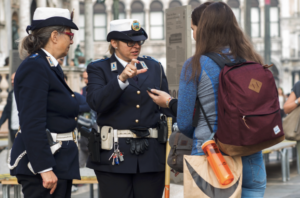
If you’re visiting Italy, these expressions will make traveling much easier.
Asking for Directions
- Dov’è…?: Where is…?
- Dov’è il bagno?: Where is the bathroom?
- Dov’è la stazione?: Where is the train station?
Asking for Help
- Mi può aiutare?: Can you help me?
- Parla inglese?: Do you speak English?
- Non capisco.: I don’t understand.
Introducing Yourself
- Mi chiamo…: My name is…
- Piacere!: Nice to meet you.
- Sono americano/a.: I am American.
Italian Restaurant Phrases

Food is one of the highlights of Italian culture, and knowing a few dining expressions makes the experience even more enjoyable.
Useful phrases include:
- Vorrei…: I would like…
- Il menù, per favore.: The menu, please.
- Il conto, per favore.: The check, please.
- È delizioso!: It’s delicious!
- Posso avere dell’acqua naturale?: May I have some still water?
Note: In Italy, you will always be offered “acqua naturale” or “acqua frizzante” (still or sparkling water).
Practicing these common expressions before visiting Italy can make ordering meals much less intimidating.
Holiday Greetings

Italian holiday traditions are rich with warm expressions.
How do you say Happy Birthday in Italian?
Buon compleanno!
This literally means “Good birthday.”
How do you say Merry Christmas in Italian?
Buon Natale!
One of Italy’s most recognized holiday greetings.
How do you say Happy New Year?
Buon anno!
Or more commonly:
Felice Anno Nuovo!
Common Italian Expressions You’ll Hear
Some words don’t translate neatly into English but appear constantly in conversation.
Va bene (Okay. / That’s fine.)
Person A: Ci vediamo alle otto? (“Will we see each other at 8?”)
Person B: Sì, va bene! (“Yes, that’s fine!”)
Dai! (Come on! / Go ahead! / No way!) Used to encourage someone, express surprise, or urge them on.
Person A: Dai, andiamo! (“Come on, let’s go!”)
Person A: Dai! (“Come on!”)
Allora (So… / Well…) A very common filler word to start a sentence or change topics.
Person A: Allora, che facciamo? (“So…what should we do then?”)
Che bello! (How nice! / That’s great!) Used when reacting positively to good news.
Person A: Ho vinto i biglietti? (“I won the tickets!”)
Person B: Che bello! (“That’s great!”)
Boh! (I don’t know. / Who knows?) A uniquely Italian expression of uncertainty.
Person A: Perché è in ritardo? (“Why is he late?”)
Person B: Boh! “(I don’t know!”)
Bonus expressions you’ll hear constantly
- Certo! – Of course!
- Magari! – I wish! / If only! / That would be great!
- Figurati! – Don’t mention it! / No problem! / Of course!
- Mamma mia – Oh my goodness!
- Che peccato! – What a shame!
More Essential Italian Phrases Every Beginner Should Know
Here are additional expressions worth adding to your vocabulary.
Asking Questions
- Come stai? How are you?
- Come si dice…? How do you say…?
- Quanto costa? How much does it cost?
- Che ora è? What time is it?
Shopping
- Posso provarlo? Can I try it on?
- Accettate carte di credito? Do you accept credit cards?
- Costa troppo. It’s too expensive.
Emergencies
- Aiuto! Help!
- Chiamate la polizia! Call the police!
- Ho bisogno di un medico. I need a doctor.
These practical phrases are especially valuable for travelers and beginners who want to communicate in everyday situations.
The Best Way to Remember Italian Phrases
Memorizing lists is a great starting point, but lasting language skills develop through regular practice and real conversation.
To reinforce the phrases you learn, try to:
- Practice a few new expressions every day
- Listen to native Italian speakers through podcasts, music, or videos
- Read simple Italian books, articles, or children’s stories
- Watch Italian films or television with subtitles
- Attend Italian cultural workshops and events
- Speak regularly with an instructor or conversation partner
Using these phrases in authentic situations helps you remember vocabulary, improve pronunciation, and develop a natural feel for the language.
For learners who want to progress beyond everyday expressions, structured instruction provides the guidance needed to build confidence. Online Italian classes with an instructor offer immediate feedback on pronunciation, explain grammar in context, and create opportunities for meaningful conversation that language apps alone cannot replicate.
Whether you’re just getting started or looking to refine your speaking skills, there are courses designed to match your goals. Italian 100 is an excellent choice for complete beginners, introducing essential vocabulary, pronunciation, and everyday conversation in a supportive environment. If you have upcoming travel and just need a baseline understanding of common phrases like the ones above, Italian language crash courses are also a good place to start.
As your skills grow, Pre-Intermediate Italian, Intermediate Italian, and Advanced Italian courses gradually expand your grammar, listening, reading, and conversational abilities while helping you communicate more naturally.
If speaking confidently is your primary goal, Italian Conversation classes are ideal for pre-intermediate and intermediate learners who want to practice real-life dialogue while strengthening vocabulary and grammar through guided discussions. Students preparing for dual citizenship can enroll in the B1 Italian Citizenship Course.
Families looking to introduce children to the language can also explore Italian classes for kids, while students seeking one-on-one instruction may benefit from private Italian lessons that provide personalized guidance and flexible scheduling.
If you’re unsure where to begin, taking the free Italian placement test can help determine the course that best matches your current proficiency, allowing you to start learning at the level that’s right for you.